
Zoë, dear, three words:
Buy a gun.
Zoë, dear, three words:
Buy a gun.
I love this book. I think it’s one of the best books about the history of video games ever written. It tells how John Carmack and John Romero both got into video game development, how they met, how Id Software was formed, and how it all fell apart. The writing style isn’t quite conversational, but neither is it as dry as most histories; the book is very easy to read. It’s also thoroughly indexed and documented, just like a history should be.
The book has its critics. Some people mentioned in the book have stepped forward to say “That’s not exactly how it happened”. Which is fine; no history book is going to be perfect (and there’s no real reason to think that these people’s versions are any more accurate than what that actually did make it into the book).
But most people who criticize the book do so on the grounds that it’s not harsh enough on Romero at the end. They point to the author’s relatively even tone as he details Romero’s actions during the development of Daikatana (which, of course, is simply the same tone the author used throughout the rest of the book). They even point to the fact the author thanked Romero in the afterward for letting him crash at Romero’s place, thus proving his inability to be objective!!!1!!lots of exclamation marks! I guess the author should have dropped his objectivity, allowed his blood to boil, and thoroughly castigated Romero for trying to make a game. Jeez.
Anyway, the book is great. You should definitely read it if you have any interest at all in the history of PC gaming.
Mental note: do not start up a new adventure game at 10:30 at night, “just to see how it looks”.
I started on Dreamfall last night. Dreamfall is an adventure game with a few action elements in it, and is the sequel to the widely praised The Longest Journey. It was developed by FunCom and published by my very own Aspyr Media.
The first thing I noticed about Dreamfall is that its keyboard/mouse control scheme is a crime against humanity. If you play this game on the PC, do yourself a favor and use a gamepad. Mine is actually a trusty green PS2 Dual Shock controller attached to a PS2-to-USB adapter, and once I got it set up properly the camera stopped whipping around wildly and the game settled down into a very nice control scheme.
The second thing I noticed about Dreamfall is that it is pretty – by far the prettiest game of its type I’ve ever played. The artists did a good job keeping the human characters out of the valley but still making them more realistic-looking and expressive than mere cartoons. The voice acting is also very good once you get past the cliched prologue. The world of the future it presents is surprisingly plausible, because it’s basically this world…only more so.
Now, that’s all fine and good, but is the game compelling? Um…yeah. It compelled me to stay up way too late seeing what would happen next, and I can’t wait to get back home this evening and play it some more.
Downsides? I played straight through the first two chapters last night and did not run into a single puzzle that gave me any trouble whatsoever. All to often, Zoë will actually tell you what you need to do. I know, I know, adventure games can’t be too hard if they are going to hit the mainstream (again), but at some point it would be nice to hit something I have to actually think about. I’m sure it’ll get tougher later.
Also the stealth and combat elements in the game are both trivially easy…why even put them in the game if you’re not going to utilize them well?
But overall, it’s off to a good start, and I haven’t even gotten to the…weirdness I know is coming.
I watched all three press conferences live. My reactions:
Nintendo: By far the best of the three conferences. They managed to present a great sense of fun, starting the moment a grinning Miyamoto took the stage with a Wii remote (I guess I’m used to the name now) to conduct a virtual orchestra that was playing the Zelda theme. The only odd part of the conference was the fact that they didn’t announce a date or a price…even though both should be obvious. The Wii will ship in either October or (more likely) November, and will cost $250 at the most. Why not just go ahead and announce?
Nintendo is in a great position for this round of the console wars. First, they are at the bottom, so there’s nowhere to go but up. They will have the cheapest console by far, with the most interesting technology. And the Wii is basically just a souped-up GameCube, which means that GameCube games will run natively (no emulation or extra hardware required) and their third-party developers already know how to make Wii games.
Sony: Sony’s conference was literally “more of the same” – the same game types we already love to play, only with graphical improvements. The PS3 is going to look fantastic, and apparently every game made for it is going to be a dirty, grimy post-apocalyptic first-person or third-person shooter. The only innovation they actually have is the tilt control, which of course was added after they saw the Wii remote and doesn’t work as well as Nintendo’s version. Tilt control is one thing, but the Wii remote actually gives you what is effectively a mouse pointer – this was explicitly demonstrated in Nintendo’s demo of Zelda: Twilight Princess.
Microsoft: Boring, boring, boring. Halo 3 trailer was terrible. The crowd snickered at Viva Pinata, even though that’s just the type of game Microsoft needs to expand their audience. It’s telling that Microsoft is currently struggling to expand its audience out of the 18-34 male demographic while Nintendo, which already has a market across all demographics, is fighting to expand the entire gaming market. And in the end, I’ve got no sympathy for Microsoft here…they are simply reaping what they sowed with their “She kicks high” crap.
It wasn’t until near the end when they demonstrated how the Xbox 360, Windows Vista and cellphones could be integrated that I perked up. That type of close integration has been necessary for a long time, and it’s strange that a game studio is having to be the one that gives it to us. So at least Microsoft can say that it has truly innovative new technology, unlike Sony.
Microsoft has one big problem, though. They launched before Nintendo announced the Wii remote. Sure, they can still make a controller with tilt features, but it won’t be standard in the box and thus developers won’t be able to rely on it being there. Now, it’s possible that Microsoft will come out with a tilt controller and push it hard and it’ll effectively become the “standard” 360 controller. Sony was able to do this with the Dual Shock controller for the PS1. But it’s going to be tough.
Big winner: Nintendo, though if they had just announced date and price it would have been a Flawless Victory.
Second: Microsoft. They truly innovated with Live and now they are extending it even further.
Loser: Sony. “We’re afraid to try new things! We’re going to give you everything you already play with better graphics! And we’ll charge you six hundred freakin’ bucks to do it!”
This just warms the cockles of my heart. (For the record, that’s the full tile sheet for Ultima VI. That site also contains full maps and tile sheets for The Savage Empire and Martian Dreams, as well.)
It’s also pretty surprising. Ultima VI was the biggest tile-based RPG of its time – the world was represented by a single map that was 1024×1024 tiles in size. The world felt large and varied, but now that I look at the tile sheet…there aren’t nearly as many individual things on it as I thought there would be. The tilesheet has 2048 tiles, but many tiles are taken up by multiple animation frames for a single object. A full 64 tiles are used just to animate the water! The designers did a good job of making different parts of the world feel different, despite the limitation.
Once again, I’m having trouble finding decent terrain tiles for Star Revolution. Not only am I having trouble finding Earthlike tiles, I can’t even begin to figure out how to find or generate tiles for non-Earthlike environments. This is all going to have to be solved, of course.
…you will see the body of your enemy float by.
Or Lucas will finally get around to releasing the version of Star Wars that you really want.
Also check out the the trailer for Lego Star Wars II on that page. That game looks like it’s going to be very, very fun.
See, this is why I probably shouldn’t have a blog. I’m inherently boring. I just don’t do enough that is interesting.
And I haven’t done enough on Star Revolution to warrant an update.
So, here’s some random stuff based on what I’ve done in the last week or so.
* I watched My Neighbors the Yamadas. Charming, funny stuff, though very Japanese. If you try it, don’t be surprised if you don’t get everything. The movie is based on a Japanese daily comic strip – imagine a Japanese version of Peanuts that includes the parents as well as the children. Most of the movie feels like very short skits that are basically animated versions of daily comics, but there are longer set pieces in there as well. My favorite part is near the beginning, when Takashi and Matsuko (the father and mother) get married.
I initially tried to watch it subtitled, but I kept missing things because the pretty animation kept distracting me from the text at the bottom, so I switched to the dubbed track. The dub was suprisingly good. When I’d heard Jim Belushi was going to voice Takashi, I was worried, but he actually does a very good job. Molly Shannon also does very well as Matsuko (she makes Matsuko’s voice sound appropriately robust). The only voice I didn’t like was…
Okay, let me make something clear here – I love Tress MacNeille. I’ve been a fan of hers for a long, long time. But I just didn’t like her as the grandmother, Shige, because she used the same “old lady” voice that she’s been using for years for characters like Agnes on the Simpsons or Mom on Futurama. If I hadn’t heard the same voice used in so many other contexts, it probably would have been fine.
* I also watched The Lion, the Witch and the Wardrobe. Loved it. An absolutely fantastic visualization of the classic children’s book…and I’ll be honest, I can’t understand why people freaked out over the Christian allegory in it; that was actually de-emphasized in the movie. I was expecting us to get some really decent fantasy movies in the wake of Lord of the Rings’ success, and I’m glad this was one of them. Now we need a great movie version of The Hobbit!
* In the wake of watching My Neighbors the Yamadas, I googled “life in Japan” and came up with this site. This is the site of Dan Laurson, who very luckily got to go to Japan on a collegiate foreign exchange program. Fortunately for us, he brought his digital camera and is good at website design.
* I mentioned briefly in a previous post that I was basing my new GUI design for Star Revolution on the concept of an immediate-mode GUI. Here’s the video presentation I watched that convinced me to give this idea a chance. So far it’s working out well! I’ll be honest, I wish that there were more podcasts and vidcasts about game development. And I don’t mean “Oooh, let’s talk about what EA did this week!”, I mean nuts & bolts, “Here’s how I implemented this effect in HLSL” kind of stuff.
And that’s it for now, I think.
The guys and gals at Bethesda made some interesting design choices when it came to Oblivion.
In particular, the stat and levelling system is…unique. Characters in Oblivion are defined by their stats and their skills. Skills go up as you use them, but stats can only be improved when you level. In most games, stats don’t change very often and really aren’t that important once character creation is done. Oblivion is the exact opposite – stats change every level, and it’s vital that you raise your stats quickly. Why?
Because how tough a monster is is based on your level. Thus, you can get a good ways into the game at level one because almost everything you fight will be “scaled” to match you. This explains how Greg Kasavin was able to go straight into several Oblivion gates and beat them during his playthrough – the game was limiting how strong his enemies could be based on his level.
You may think “Okay, then there’s no sense in levelling, since fights won’t get easier based on my level”. That’s not true, because there are many enemies in the game you won’t be able to beat unless you raise your stats – thus making your level 4 character more effective than the level 4 monster you are fighting.
Thus, it’s vital to get very large stat bonuses out of each level, especially at the beginning of the game. It’s especially vital to raise your Endurance stat as quickly as you can, since that stat governs how many more hit points you get every time you level up.
So how do you make sure you get large stat bonuses every level? You use skills based on that stat a lot. In order to get that magic +5 to Endurance when you level, you must gain ten points in Endurance-based skills. The easiest way to do that is to use the Armorer skill constantly, repairing your own weapons and armor and also repairing every bit of enemy equipment you find, even if you’re just going to drop it afterwards. The best way to get +5 on your Intelligence is to either use Mysticism magic a lot or do a lot of Alchemy.
What this means is that just going straight for the game’s dungeons and fighting everything in them will cause you level too fast – you’ll get to a new level without having gained ten points in a skill, so you don’t get that nice +5 bonus…you may just get some +2 or +3 bonuses. That’s not very effective levelling and it will come back to bite you in the ass if you do it a lot. Enemies will become more and more powerful and you just won’t be able to keep up. This system was specifically designed to punish powerlevellers.
Which means that you’re going to end up doing a lot of busywork to get your skills up between dungeon runs. You’ll make a bunch of potions, fix a bunch of armor, or cast a single spell over and over again. Only when you know you’ve got those nice +5 bonuses waiting for you will you go into a dungeon, fight and gain a level.
Now, that sounds like really poor design, and when I first read about how the system was structured I hated it. I also had to start over, since I hadn’t been levelling effectively enough.
But the system forced me to use many skills I otherwise wouldn’t have touched, like Alchemy. And I realized that those skills were really useful and…fun. The system forced me to try everything, and I discovered some stuff in the game that I liked that I otherwise would have missed. So…bad design? I initially thought so, but now I’m not so sure.
The real problem with this system is that Bethesda doesn’t tell you anywhere in the game or documentation that levelling quickly is bad, and that you should try to gain at least ten points in at least three minor skills before every level gain. That’s definitely bad. But now that I understand it, I’m having even more fun with the game than I was before.
For the record, here’s the custom character class I created:
PRAGMADIN
The Pragmadin is a pragmatic paladin. He is a holy warrior of light, capable of bashing the skulls of the wicked with his mace while simultaneously healing the faithful. He would never steal or do evil, but he does understand that sometimes it’s necessary to sneak around or pick a lock or two…for the good of all, of course.
Class focus: Combat
Favored stats: Strength, Endurance, Intelligence
Major skills: Blunt, Block, Heavy Armor, Restoration, Illusion, Destruction, Security
I play a male Imperial who was born under the sign of the The Warrior. This gives me a high starting Endurance – not the highest in the game, but I was willing to trade ten initial points of Endurance for the ability to be an effective spellcaster right away (Orcs and Redguards both have higher starting Endurance but have almost no magical ability to start).
Just about everything else in Oblivion is note-perfect. The game is gorgeous and runs well at high detail on my computer. The little minigames for subsystems like Speechcraft and Security are fun. The quest system works really well and seems bulletproof. The game does a good job of keeping track of all the info you accumulate during the game, with both local and world maps that update automatically, a journal and an active quest system. Combat is visceral and good maneuvering on your part can allow you to overcome an enemy who is technically more powerful than you. There’s also just a stupid-huge number of things that can happen to your character during the course of a game. Sell a certain artifact and you may be approached by a man who wants you to find more of them. Kill a vampire and you may get invited to join a clan of vampire hunters. Or you can become a vampire yourself.
Basically, it’s the best game I’ve played in years…and unless it finds a way to seriously kick me in the nuts, it could go down as the best game I’ve ever played, ever. We’ll see.
I finally found the perfect metaphor to describe my disappointment with end-game World of Warcraft.
Before you hit level 60, WoW is a game that rewards effort and time played. You can log in for just a little while, do a little something, and know that you’ve made some progress (no matter how small) towards improving your character. And this is exactly how I played WoW before 60 – in small, daily chunks.
Once you hit 60 WoW turns into a slot machine. Rewards are no longer commensurate to effort or time played; they are now completely random. Not only does WoW become a slot machine, but you have to be willing to play the game for three to five hours straight to get one pull on the slot machine – and that pull will almost certainly be a loser. Sorry, you’re not a winner! Run UBRS again!
It was very disconcerting watching one of my favorite games become one of my least favorite. But Friday night I got my copy of Oblivion, so WoW can now kiss my ass.
Starflight has long been one of my favorite games, although its interface is very annoying…sometimes I wonder how I put up with stuff like that when I was younger (answer: I didn’t have another space opera RPG to compare it to, of course).
I’ve been playing Starflight 1 and 2 again as reference for Star Revolution. I was playing Starflight 2 when I noticed something odd…look at this screenshot. Doesn’t it look weird in some way?

And doesn’t this screenshot of Starflight 1 look kind of…chunky? Even for a 320×200 game?
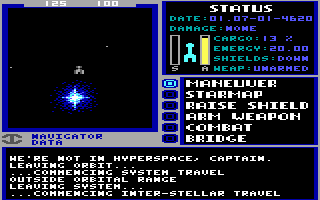
In fact…
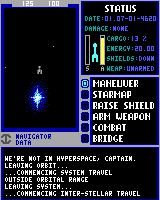
This is a screenshot for the original Starflight reduced to 160×200. Notice that all of the text is still readable and all the graphics look the same, just narrower. It’s almost as if the game were written to run in 160×200…which is exactly what it was. Starflight was written to run in a 160x200x16 color mode available on some CGA/composite monitor combinations (most notably Tandy and Compaq computers). When the EGA and VGA versions were created, the image was simply doubled horizontally.
Which brings us back to the Starflight 2 screenshot.
Notice how much more detailed the picture of the Tandelou Eshvey looks than the rest of the interface! The developers of Starflight 2 did not bother to try to make the interface look any better, even though Starflight 2 was written specifically for VGA! The only thing they did was use the additional horizontal resolution to make the font a bit clearer. How disappointing!


